Can You Install Your Own EV Charger in Toowoomba? Why Professional Installation is Crucial
Why You Cannot Legally Install Your Own EV Charger
I get this question regularly. Someone has just picked up a new EV, they have watched a few YouTube videos, and they reckon they can save a few hundred dollars by wiring in the charger themselves. I understand the temptation, but the short answer is no, you absolutely cannot do this yourself, and attempting it could cost you far more than you would ever save.
In Queensland and across Australia, all fixed electrical wiring work must be performed by a licensed electrician. That includes installing new circuits, running cable, and hardwiring appliances like EV chargers. This is not a grey area. The Queensland Electrical Safety Act 2002 is explicit about it. Penalties for unlicensed electrical work include fines up to $40,000 for individuals, criminal prosecution if someone gets hurt or property is damaged, insurance claim denial, and complications if you ever try to sell the property. The Electrical Safety Office actively investigates unlicensed work, particularly after electrical fires or injuries.
The Real Danger of High-Power Circuits
EV chargers are not like plugging in a toaster. A typical home charger draws 32 amps or more on a continuous basis, often running for eight hours straight overnight. Working with 230V or 400V circuits without proper training, isolation procedures, and testing equipment creates a severe risk of electric shock. At 32 amps, electric shock can cause cardiac arrest, severe internal and external burns, muscle contractions that prevent you from releasing the conductor, respiratory paralysis, and death.
Licensed electricians use specialised testing equipment, lockout and tagout isolation procedures, and personal protective equipment to eliminate these risks. We train for years to develop the knowledge and instincts that keep us safe around live electrical systems. A YouTube tutorial does not replicate that.
Fire Risk from Incorrect Installation
Incorrect EV charger installation is a genuine fire hazard. The most common DIY mistake is using undersized cable. A 32A single-phase charger requires minimum 6mm squared cable, and typically needs 10mm squared for longer runs. A 40A charger needs at least 10mm squared, sometimes 16mm squared. These calculations have to account for cable run length, installation method, ambient temperature, de-rating factors for multiple circuits in the same conduit, and the continuous nature of the load. Get the cable sizing wrong and you end up with cable operating above its temperature rating, slowly degrading the insulation until it fails.
Then there is the circuit protection. EV chargers need a correctly matched circuit breaker, RCD protection at 30mA minimum (Type A at a bare minimum, Type B preferred), surge protection for the charger electronics, and an isolation switch within 2 metres of the charger as required by AS/NZS 3000:2018. Miss any of these and you remove vital protection against overloads and earth faults.
Loose or badly terminated connections are another common DIY problem. Insufficient terminal torque, damaged conductor strands, wrong terminal types, or exposed conductors at terminations can all cause arcing and overheating that ignites surrounding materials. According to Queensland Fire and Emergency Services, electrical faults cause approximately 40% of house fires in Queensland, with faulty installations being a leading contributor.
The Financial Fallout
A botched DIY installation can damage your EV charger ($800 to $3,000 or more), your vehicle's onboard charging system ($5,800 or more to repair), and your home's wiring and switchboard. Reverse polarity, overvoltage from poor connections, and surge damage from inadequate protection can fry expensive electronics. Most EV manufacturers specifically state that charging system warranties are void if damage results from non-compliant installation. Tesla, Nissan, Hyundai, and others all recommend licensed electrician installation.
Then there is insurance. If an electrical fire or damage occurs because of unlicensed DIY work, your home insurance claim will almost certainly be denied. That could mean $300,000 to $800,000 in rebuild costs for a total fire loss, $50,000 to $200,000 for partial damage and smoke remediation, liability for neighbouring property damage, and no temporary accommodation coverage. Your charger manufacturer warranty requires installation by a licensed electrical contractor, compliance with AS/NZS 3000, an Electrical Safety Certificate, and proper earthing and RCD protection. DIY installation voids all of this.
Want this sorted properly?
Glenn quotes most Toowoomba jobs within 48 hours, and the person who quotes is the person who turns up.
Understanding What You Are Dealing With
The portable Level 1 charger that came with your EV plugs into a standard power point and does not require any installation work, but it only adds 12 to 15 km of range per hour. Most people find it too slow for daily use and arrange a proper Level 2 wall-mounted charger, which is the most common home installation in Toowoomba.
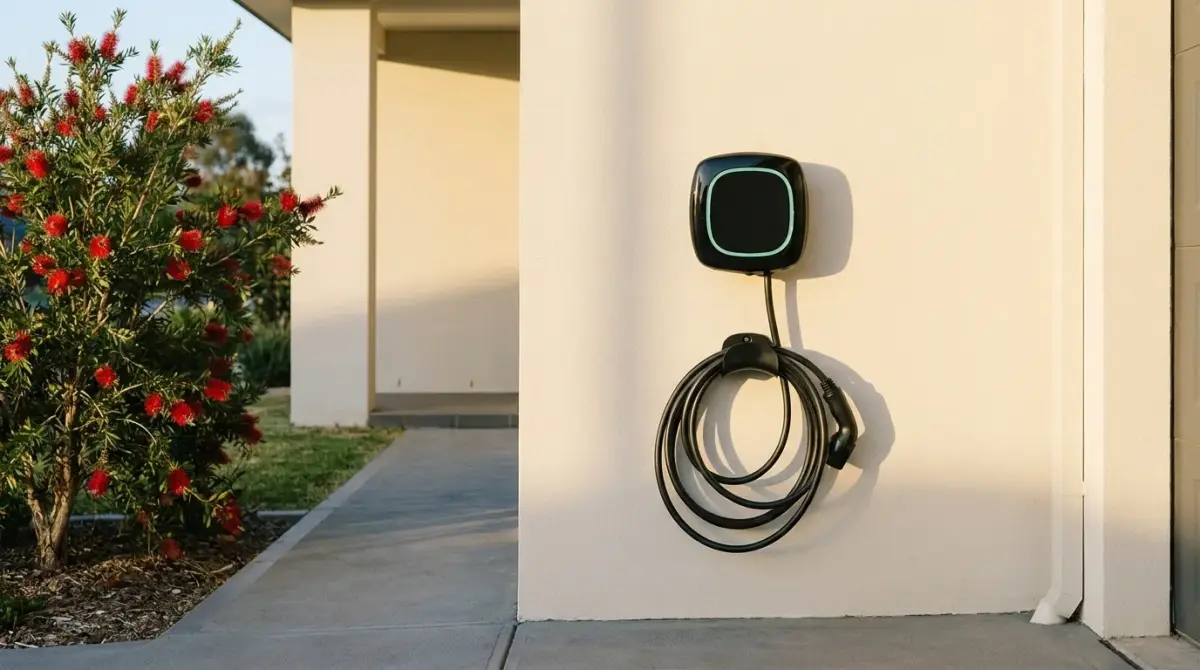
A Level 2 charger runs on a dedicated 32A to 40A single-phase circuit, delivering 40 to 50 km of range per hour. The installation involves a new circuit breaker in the switchboard, a dedicated cable run of 6 to 10mm squared minimum, RCD and RCBO protection, an outdoor-rated installation at IP65 rating, an isolation switch, earthing and surge protection, and full testing and certification. This is serious electrical work that requires professional skills.
Three-phase chargers at 11 to 22kW are faster again but add significant complexity. They require three-phase supply, larger switchboard capacity, and more involved cable sizing and protection. Not all Toowoomba properties can support them.
Your Switchboard Needs a Professional Assessment
Before any EV charger goes in, a licensed electrician needs to assess your switchboard's total capacity. A typical Toowoomba home already runs air conditioning at 15 to 25 amps per unit, electric hot water at 20 to 25 amps, a cooktop and oven at 20 to 40 amps, multiple general power and lighting circuits, and possibly pool equipment. Adding a 32 to 40 amp EV charger on top of all that requires careful load calculations, diversity factor analysis, and possibly a main switch upgrade, load management system, switchboard replacement, or three-phase supply upgrade.
RCD protection for EV chargers also has specific requirements. Type A RCD is the minimum legal requirement under AS/NZS 3000:2018, detecting AC and pulsating DC residual current. Type B RCD is preferred because it also detects smooth DC residual current from EV charging electronics. At G-TEC, I install Type B RCD protection for all EV charger installations, exceeding the minimum requirements for your safety.
What Happens When DIY Goes Wrong
Electrical industry reports document plenty of cautionary tales. A Brisbane homeowner in 2023 installed their own EV charger using 4mm squared cable instead of the required 10mm squared. After three months, the cable insulation degraded, caused an arc fault, and started a house fire. Damage exceeded $180,000 and insurance denied the claim. A Gold Coast DIY installer in 2024 reversed the active and neutral conductors, destroying the charger's electronics and the vehicle's onboard charger, totalling $8,200 in damage with both manufacturer warranties voided. An Ipswich homeowner received a severe electric shock from touching the metal charger casing due to a missing earth connection, spent six weeks recovering in hospital, and copped an $8,500 fine from the ESO. In the Toowoomba region in 2024, a DIY installation without proper switchboard assessment overloaded the main switch, requiring a complete switchboard replacement and charger reinstallation that cost $3,500 more than a professional installation would have.
Every one of these situations was entirely preventable with licensed electrician installation.
What Professional Installation Actually Involves
I start with a thorough site assessment, checking the optimal charger location, cable route, switchboard capacity, and existing wiring condition. We discuss your charging speed needs, budget, and timeline, and I provide a written quote with a detailed breakdown.
The installation itself follows a methodical process. I isolate the power supply using lockout and tagout procedures, install the circuit breaker and RCD in the switchboard, run correctly sized cabling from switchboard to charger location using appropriate conduit or cable tray, and install a weatherproof isolation switch within 2 metres of the charger. The charger gets mounted securely, connected according to manufacturer specifications, and every termination is verified for correct polarity and torque.
Testing is thorough: insulation resistance at minimum 1 megaohm at 500V DC, earth continuity at maximum 0.5 ohms resistance, RCD trip time within 300 milliseconds, polarity verification, voltage drop under load at maximum 5%, and full functional testing of the charger and its safety features. Then I issue your Electrical Safety Certificate, which is lodged with the Electrical Safety Office as legally required.
Learn more about our professional EV charger installation service.
The Smart Choice is the Safe Choice
The convenience of home EV charging should never come at the cost of safety or legality. The risks of DIY electrical work on high-power circuits are simply too great, and the potential costs of getting it wrong dwarf any savings you might hope for. For safe, compliant, and reliable EV charger installation in Toowoomba, give me a call on 0489 082 307 for an assessment and quote.