Saving Energy & Money: The Real Benefits of LED Downlights in Toowoomba
Why LED Downlights Are Worth the Upgrade
If you still have halogen downlights in your Toowoomba home, you are spending more on lighting than you need to, and your ceiling cavity is running hotter than it should be. I upgrade halogen to LED downlights regularly, and every single customer notices the difference on their next power bill.
Halogen downlights draw 50 watts each. An equivalent LED downlight uses 7 to 10 watts and produces the same brightness, often better. That is an 80 to 86 percent reduction in energy use per light. In a home with 20 or 30 downlights, the savings are substantial. But energy efficiency is just one part of the story.
The Energy Savings Are Real
Let me run through the actual numbers for a typical Toowoomba home. Take a living room with 8 halogen downlights running 5 hours a day. Those 8 halogens at 50 watts each draw 400 watts total, consuming about 182 kWh per quarter and costing around $49 on your power bill. Replace them with 8 LED downlights at 8 watts each, and total draw drops to 64 watts. Quarterly consumption falls to 29 kWh, costing about $8. That is a saving of $41 per quarter from one room alone, or $165 per year.
Scale that up to a whole-home upgrade of 32 downlights and you are looking at annual savings of around $528. Over five years, that is $2,641. Over ten years, $5,283. And that is just the direct energy savings. LEDs run so much cooler than halogens that your air conditioning works less hard in summer, which can add another $50 to $150 per year in Toowoomba's climate.
"After Glenn replaced all our halogen downlights with LEDs, our next power bill dropped by over $100. We couldn't believe the difference! The lights are brighter, and we're not constantly replacing globes anymore." — David & Lisa, Rangeville
Safety You Can Feel
Halogen downlights get extremely hot during operation. If ceiling insulation is too close, and in older homes it often is, that heat creates a real fire risk. I have pulled back insulation in ceiling cavities and found it scorched brown around old halogen fittings. LEDs produce very little heat by comparison, making them far safer to operate and allowing insulation to sit right up against IC-rated fittings without any safety concerns.
The Queensland Building Code requires IC-rated fittings where insulation is present, and modern IC4-rated downlights take this further with enhanced insulation contact properties. Non-IC rated downlights that need 100mm clearance from insulation create cold spots in your ceiling insulation and waste energy. Every LED downlight I install uses appropriate IC-rated fittings for your ceiling insulation situation.
Light Quality and Flexibility
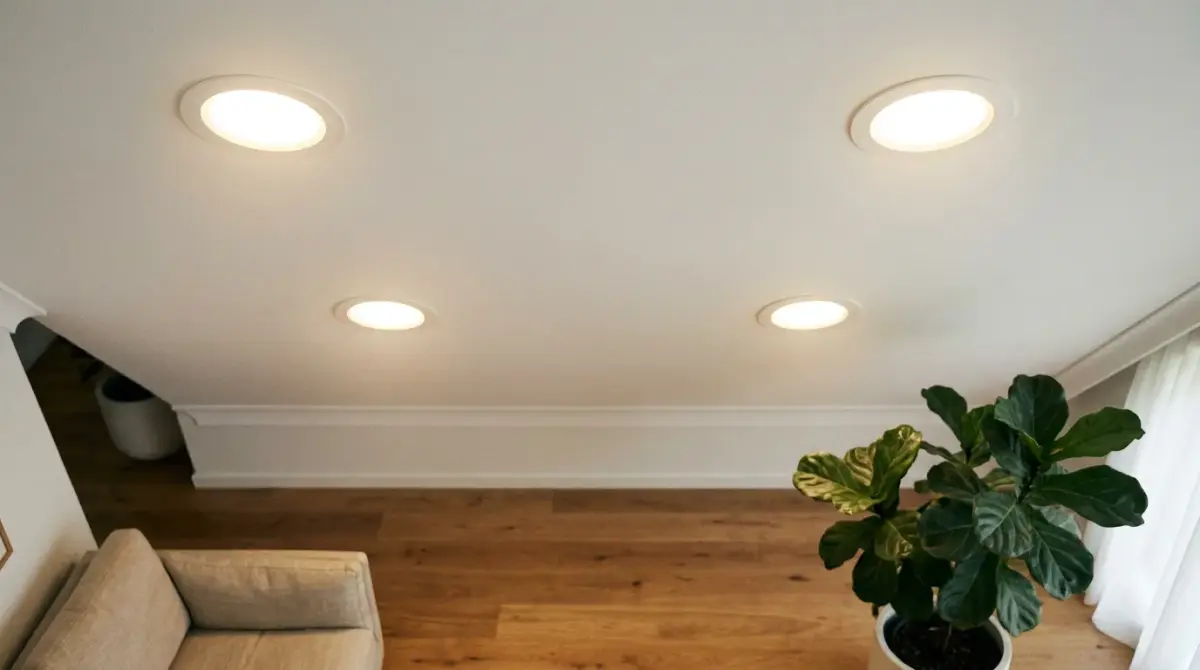
LED technology gives you far more control over the look and feel of your lighting than halogens ever did. You can choose warm white at 2700K to 3000K for a cosy glow in living rooms and bedrooms, neutral white at 3500K to 4000K for kitchens and bathrooms where you want true colour rendering, or cool white at 4500K to 5000K for workshops and garages where you need crisp, detailed visibility.
Dimmable LED downlights let you adjust brightness to suit different times of day and activities, but there is an important catch. LED dimmers are not the same as old halogen dimmers. If you put dimmable LEDs on an old incandescent dimmer switch, you will get flickering, buzzing, and premature failure. I always replace the dimmer switch with an LED-rated unit when doing LED upgrades, which runs $80 to $150 per dimmer including installation.
"We used G-TEC for installing new downlights... Glenn's workmanship was excellent, very neat and tidy. He gave great advice on LED options too. Very happy with the result." — Megan & Dave
Want this sorted properly?
Glenn quotes most Toowoomba jobs within 48 hours, and the person who quotes is the person who turns up.
The Lifespan Advantage
Halogen globes last 1,000 to 2,000 hours. Quality LED downlights are rated for 25,000 to 50,000 hours. At average residential use, that works out to 15 to 25 years before they need replacing. That means no more climbing ladders every few months to change blown globes, and no more buying replacement halogens at $5 to $15 each.
That said, not all LEDs are created equal. Budget LEDs in the $10 to $25 range often use cheaper driver components and may only last 10,000 to 15,000 hours, with poorer colour rendering and a tendency to flicker. Quality LEDs in the $35 to $70 range from brands like Clipsal, Hager, and HPM use better drivers, offer CRI ratings of 80 to 90 for truer colours, come with 3 to 5 year manufacturer warranties, and genuinely deliver on that 25,000 to 50,000 hour lifespan promise.
Cost and Return on Investment
LED downlight installation in Toowoomba costs $110 per downlight including the fitting and professional installation. A whole-room upgrade of 8 to 12 lights starts from $880, and a whole-home upgrade of 25 to 35 lights starts from $2,750.
For that 8-light living room example, the payback period is approximately 5.3 years based on $165 in annual energy savings. After payback, the savings continue for the remaining 15 to 20 years of the LED's life. Add in the savings from not buying replacement halogen globes and the reduced air conditioning load, and the real-world payback is often shorter.
For most Toowoomba homeowners, quality professional LED installation offers the best balance of cost, savings, and reliability compared to either budget LEDs that fail early or premium smart LEDs that take longer to pay back.
Choosing the Right Colour Temperature Room by Room
Getting the colour temperature right makes a big difference to how a room feels. For living rooms, dining rooms, and bedrooms, 2700K warm white creates a relaxed, cosy atmosphere similar to traditional incandescent lighting. This works particularly well in Toowoomba heritage homes where you want to complement traditional timber tones.
Kitchens, bathrooms, and home offices suit 3500K to 4000K neutral white, which provides a balanced, natural light quality that is good for detailed tasks without feeling harsh. Garages, workshops, and laundries benefit from 4500K to 5000K cool white for maximum visibility.
Within a single open-plan space, keep the colour temperature consistent so the lighting looks cohesive. But there is no reason you cannot use warm white in your bedroom and neutral white in your ensuite. I help plan the colour temperature room by room during every LED upgrade consultation.
Environmental Impact
Beyond the personal savings, LED lighting significantly reduces your household's carbon footprint. Queensland electricity generates approximately 0.67 kg of CO2 per kWh. A whole-home LED upgrade of 32 lights reduces annual energy consumption by about 1,955 kWh, which translates to a CO2 reduction of roughly 1,310 kg per year. Over ten years, that is over 13 tonnes of CO2 avoided. Upgrading to LED downlights is one of the most effective single actions Toowoomba homeowners can take to reduce their environmental footprint.
Installation Scenarios
Retrofit replacement, where you already have downlights in good positions and just need the fittings swapped, is the quickest and least disruptive option. It typically takes 2 to 4 hours for a room with minimal mess. New installations where you want downlights added to rooms that do not currently have them require ceiling cutting, wiring from the switchboard or existing circuits, and take 4 to 6 hours per room. Complete lighting redesigns, often done during renovations, involve removing old fixtures, patching unnecessary holes, and installing LEDs in new optimal positions.
I provide detailed quotes for each scenario, specifying scope, timeline, and expected disruption so you know exactly what to expect.
If you are ready to stop overpaying for lighting and start enjoying better light quality, less heat, and lower power bills, give me a call on 0489 082 307 and I will come out for a no-obligation assessment of your current lighting setup.