What Factors Influence Ceiling Fan Installation Costs in Toowoomba?
Why Ceiling Fan Installation Costs Vary So Much
One of the most common questions I get from Toowoomba homeowners is a simple one: "How much to put in a ceiling fan?" And the honest answer is always, "It depends." Not because I'm trying to dodge the question, but because two jobs that look identical from the outside can involve completely different amounts of work once you're up in the ceiling space.
A straightforward replacement where you're swapping an old fan for a new one on existing wiring typically costs around $165. A brand new installation point, where there's no wiring or ceiling support in place, sits closer to $300. The gap between those two figures comes down to a handful of practical factors that I'll walk you through here.
Replacement vs. New Installation Point
The single biggest factor in ceiling fan installation cost is whether you're replacing an existing fan or fitting one where none existed before.
Replacing a fan that's already got suitable wiring and a proper ceiling mount is the quicker job. You're essentially disconnecting the old unit, connecting the new one, and making sure everything is secure and balanced. That's typically 30 to 60 minutes of work, coming in at $165.
A new installation point is a different story. I need to run fresh cable from a power source to the fan location, often install a new wall switch, and make sure the ceiling structure can actually support the fan's weight and vibration. That takes 1.5 to 2.5 hours and costs from $300, depending on how accessible the roof space is and how far the cable needs to run.
How Your Home's Construction Affects the Price
The type of walls in your Toowoomba home has a real impact on how quickly I can get new wiring to a switch location.
Brick veneer homes, which are common across the newer suburbs, have timber-framed cavities between the external brick and internal plasterboard. That cavity makes cable routing fairly straightforward.
Weatherboard and timber homes, particularly the older character places around East Toowoomba and the inner suburbs, tend to have accessible timber-framed cavities as well. They can actually be easier to work with than you'd expect.
Double brick walls are the tricky ones. They're less common but do turn up in some of Toowoomba's older character homes. Installing a switch in solid double brick means cutting chase channels, which is labour-intensive and can add $100 to $200 or more to the job.
Ceiling Height and Access
Standard ceiling heights of 2.4 to 2.7 metres are no drama. A step ladder, basic tools, and the job moves along efficiently.
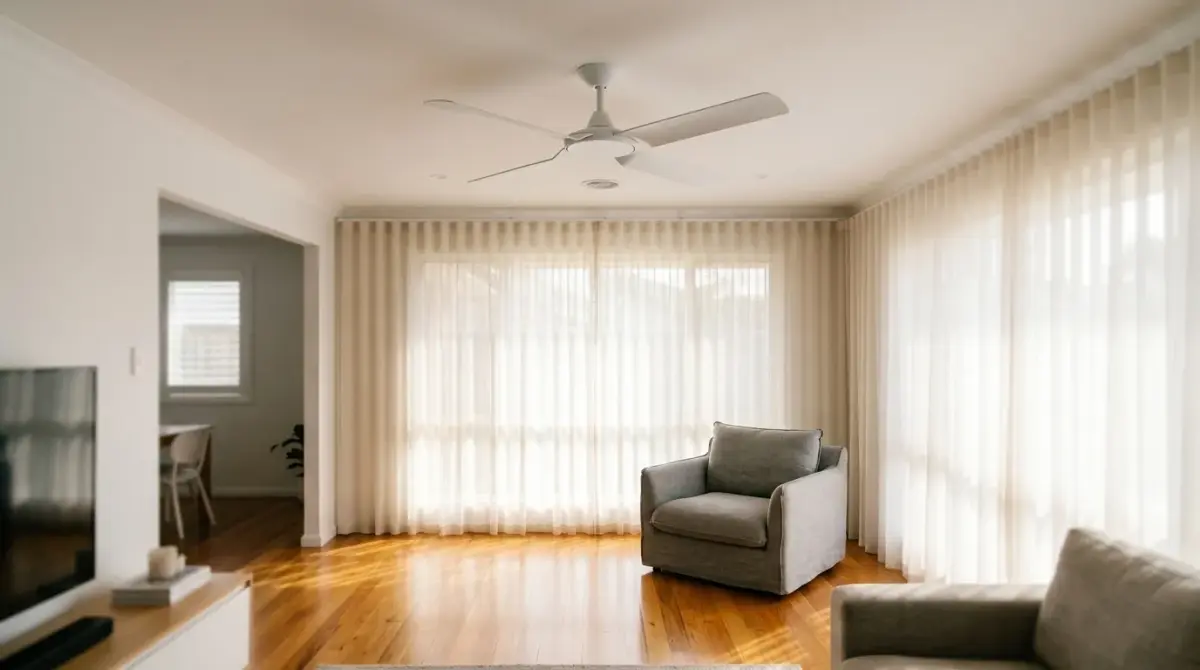
High ceilings of 3 metres or more are a different situation. Taller access equipment, extra setup time, and sometimes a second pair of hands push costs up by around $300 per fan. Those beautiful high-ceilinged Queenslanders look fantastic with a ceiling fan spinning away, but the installation reflects the extra work involved.
Roof space access matters too. If I can get into the ceiling cavity easily to run cable and check the mounting structure, the job stays straightforward. Flat roofs or tight spaces with no access mean working from below, which takes longer and costs more.
Fan Type and What You're Fitting
The fan itself doesn't change the labour price dramatically, but more complex units do add time. A simple fan-only unit with a wall controller is the quickest to wire up. Add a light kit and you've got extra wiring for the light circuit. Remote control fans need a receiver module installed in the canopy, which adds 15 to 30 minutes.
Outdoor-rated fans for alfresco areas need to be specifically rated for those conditions, and the wiring needs appropriate weatherproofing. That adds a bit more care and time to the installation.
Want this sorted properly?
Glenn quotes most Toowoomba jobs within 48 hours, and the person who quotes is the person who turns up.
AC vs. DC Motors and Running Costs
This isn't directly an installation cost factor, but it's worth understanding because it affects the total value of what you're spending.
AC motor fans are the traditional option. They use 50 to 100 watts, cost $150 to $400 to buy, and will run you $40 to $80 a year in electricity at Toowoomba's rates of roughly $0.28 to $0.32 per kilowatt hour.
DC motor fans use 35 to 70 watts, cost $300 to $600 or more, and run at $15 to $35 per year. They're also noticeably quieter, which matters a lot in bedrooms. Over a 10-year period, the total cost of ownership is often 30 to 50 per cent lower for DC motors despite the higher purchase price.
Smart Fans vs. Standard Fans
Smart ceiling fans with WiFi connectivity cost $300 to $800 compared to $150 to $400 for standard models. Installation runs slightly higher too, typically $50 to $100 extra for configuring the wireless setup. The convenience is genuine, especially if you're already running a smart home system, and the energy optimisation features can recoup the price difference over 5 to 8 years.
Timing Your Installation
Summer between November and March is peak season for ceiling fan installations in Toowoomba. Every electrician in town is booked out, and quality tradies have wait times of weeks. I keep my pricing transparent year-round, but if you want the best availability and shortest wait, plan your installation for spring in September or October.
Winter from June to August is the quiet season. You'll often find greater availability, shorter wait times, and some suppliers discount their fan stock by $50 to $150 during the cooler months.
Multi-Fan Discounts
Installing multiple fans in a single visit is more efficient, and that efficiency gets passed on. A single fan is full price, but two to three fans typically attract a 5 to 10 per cent discount per fan. Four to five fans bring that to 10 to 15 per cent, and whole-house upgrades of six or more fans can qualify for package discounts of 20 to 25 per cent per fan.
If you're building or renovating and know you'll want fans throughout, it's well worth getting them all done in one go.
Light Kits and Noise Levels
Adding a light kit to your ceiling fan means separate wiring and potentially a multi-function wall switch. Basic single globe kits run $40 to $80, multi-LED arrays $80 to $150, and designer options $150 to $300 or more. LED kits cost more upfront but save $40 to $60 annually in electricity and last significantly longer.
Noise is something people often overlook until the fan is spinning above their bed at 2am. Quality DC motors sit at 35 to 42 decibels, which is virtually silent. High-quality AC motors are 40 to 48 decibels. Budget AC motors can hit 48 to 55 decibels, which becomes genuinely distracting in a quiet bedroom. Spending an extra $200 to $400 on a premium motor makes a real difference to your sleep quality.
Warranty and Longevity
Budget fans in the $150 to $300 range typically carry 1 to 3 year motor warranties and last 5 to 8 years. Mid-range fans at $300 to $600 come with 3 to 7 year warranties and 10 to 15 year lifespans. Premium fans above $600 often have 10 to 25 year motor warranties and can run for 20 to 25 years.
That premium fan might feel like a big outlay, but when you spread the cost over its lifespan, it often works out comparable to or cheaper than replacing budget fans every few years.
Getting an Accurate Quote
Every ceiling fan installation is a bit different, and the only way to get an accurate price is to have a proper look at the job. I can usually give you a clear quote over the phone if you can tell me whether it's a replacement or new point, what your ceiling height is, and what type of fan you're looking at. For anything more complex, a quick site visit sorts it out.
If you're planning ceiling fan installations for your Toowoomba home, give me a call on 0489 082 307 and we'll work out exactly what's involved.